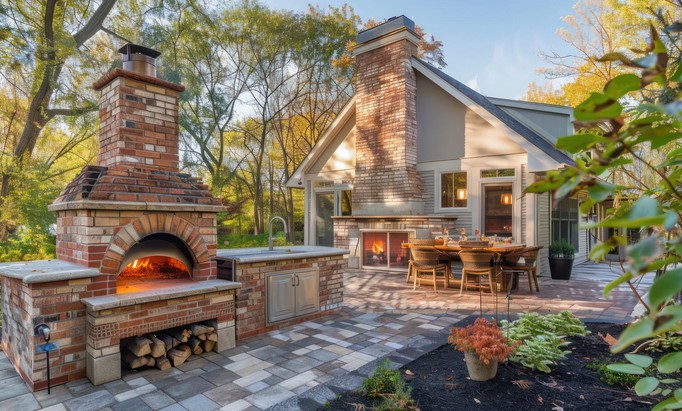
The sun is setting, a bottle of Sangiovese is breathing on the counter, and your guests are gathered around a glowing hearth. In less than 90 seconds, a hand-stretched Margherita slides off a floured peel, boasting a perfectly charred “leopard-spotted” crust that no indoor kitchen could ever replicate. This isn’t just dinner; it’s a performance.
In my decade of designing high-end exterior living spaces, I’ve seen trends come and go—from outdoor kitchens that look like stainless steel showrooms to fire pits that nobody actually sits around. But nothing transforms a backyard from a “yard” into a “destination” quite like an Outdoor Pizza Oven. It is the ultimate anchor for residential amenity branding, shifting the focus from mere property value to a curated lifestyle experience.
The “Hearth” of the Modern Home: Why It’s More Than an Appliance
I often tell my clients that adding an Outdoor Pizza Oven is like adding a fireplace to a living room; it provides a primal, visual center of gravity. However, for the beginner, the technical barrier can feel steep. You aren’t just buying a grill; you are investing in a high-thermal-mass cooking instrument.
From a branding perspective, an oven tells a story of craftsmanship and hospitality. In the luxury real estate market, a built-in wood-fired oven signals that the homeowner values “slow food” and authentic social interaction. It’s an emotional ROI that standard BBQ islands simply can’t touch.
The Battery Analogy
Think of an Outdoor Pizza Oven like a high-capacity battery. You spend time “charging” it (pre-heating the refractory bricks), and once it’s full of thermal energy, it releases that heat consistently to cook your food. If you have a “leaky” battery (poor insulation), you’ll burn through fuel and never hit those critical 800°F+ temperatures.
Technical Foundations: Choosing Your Heat Source
When you start your deep-dive into the world of outdoor ovens, you’ll face the classic dilemma: Wood-fired, Gas, or Hybrid? After 10 years in the field, I’ve developed a “use-case” framework to help you decide.
1. The Purist’s Path: Wood-Fired
This is the gold standard for “Residential Amenity Branding.” There is a specific aroma and a “dry heat” that only hardwood (like oak or maple) can provide.
-
The Insight: It requires a learning curve. You have to manage the “flame lick” and understand coal bed management.
-
The Brand Appeal: It looks stunning. A stone-clad wood oven is a permanent architectural statement.
2. The Modernist’s Choice: Gas-Powered
If you value convenience and precision, gas is your best friend. With the turn of a dial, you’re ready to cook in 20 minutes.
-
The Technical Edge: Gas ovens provide a constant, predictable BTU output. This is perfect for the intermediate cook who wants to focus on dough hydration rather than wood chopping.
3. The Hybrid System: The Best of Both Worlds
Many high-end builds now utilize dual-fuel kits. You start the heat with gas to save time, then add a few sticks of wood for that signature smoky finish. In my professional opinion, this is the smartest investment for long-term versatility.
Engineering the Zone: Strategic Placement and Safety
I’ve seen too many $5,000 ovens tucked away in a dark corner where the chef is isolated from the party. Integration is about Social Flow Engineering.
-
The “Landing Zone”: You need at least 3 feet of prep space immediately next to the oven. Stretching dough and “peeling” the pizza requires elbow room.
-
Prevailing Winds: This is a technical detail beginners often miss. If your oven mouth faces the wind, the heat will be blown out of the dome, and smoke will be pushed into your guests’ faces.
-
Thermal Clearance: Even if an oven is “well-insulated,” the exterior can get warm. Ensure you have the proper non-combustible hearth and clearance from wooden pergolas or siding.
💡 Tips Pro: The “Floor Temp” Secret
Beginners often obsess over the air temperature gauge on the door. Ignore it. The air temperature doesn’t cook the bottom of your pizza; the floor temperature does. Invest $20 in an Infrared Laser Thermometer. You want your cordierite or firebrick floor to be between 700°F and 750°F (370°C – 400°C) before the first pie hits the deck.
Materials Matter: Refractory Strength vs. Portable Convenience
There are two main categories of Outdoor Pizza Oven construction, and your choice depends on whether you want a “landmark” or a “tool.”
Stainless Steel Domes
These are often portable or countertop models. They heat up incredibly fast (15-20 minutes) because they use high-density ceramic fiber insulation between sheets of steel. They are great for “immediate gratification” but lose heat quickly once the flame dies down.
Traditional Refractory/Brick Ovens
These are the heavyweights. They take 1-2 hours to “heat soak,” but once they are hot, they stay hot for a long time.
-
The “Leftover” Benefit: I love telling my clients that a brick oven is a 24-hour tool. You cook pizza at 800°F at night. By morning, the oven is still at 350°F—perfect for baking artisan sourdough bread. By the afternoon, it’s at 225°F—ideal for slow-roasting a lamb shoulder.
The “Soot” Factor
If you are building your oven under a roof or a covered pavilion, you MUST account for the chimney flue and spark arrestor. I once saw a gorgeous cedar tongue-and-groove ceiling ruined in a single summer because the homeowner didn’t extend the chimney high enough. Creosote and soot will settle on everything if your ventilation isn’t engineered for the specific draft of your oven.
Scannable Integration Checklist
| Feature | Wood-Fired | Gas-Fired |
| Pre-heat Time | 45 – 90 Minutes | 15 – 30 Minutes |
| Flavor Profile | Authentic Smoky/Char | Clean/Neutral |
| Maintenance | Ash removal required | Minimal |
| Skill Level | Intermediate/Advanced | Beginner/Intermediate |
| Visual Impact | High (Atmospheric) | Sleek/Modern |
Conclusion: Crafting Your Exterior Legacy
Integrating an Outdoor Pizza Oven into your home isn’t just about food; it’s about “Branding” your lifestyle. It signals a move away from the frantic pace of modern life toward a more intentional, tactile way of entertaining. Whether you choose a sleek stainless-steel unit for your balcony or a massive, hand-built brick dome for your patio, you are creating a theater of flavor.
In my 10 years of experience, I’ve found that the best “amenities” are the ones that actually bring people together. The pizza oven does this better than any other outdoor feature I know. It turns a meal into an event and a backyard into a sanctuary.
Are you a Wood-Fired Purist or a Gas-Powered Modernist? The choice of fuel dictates the design of your entire outdoor kitchen. If you’re struggling to figure out how to vent an oven under your existing deck or which stone veneer will withstand the heat, drop a comment below. Let’s build your legacy, one slice at a time.