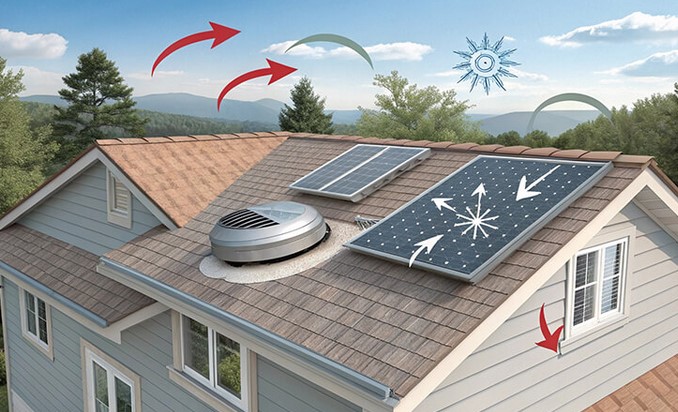
It’s 2:00 PM in the middle of July. Your air conditioner is screaming, running at full tilt, yet the upstairs bedrooms still feel like a literal sauna. You touch the ceiling, and it’s warm to the touch. In my decade of climbing into suffocating crawlspaces, I’ve seen attics hit staggering temperatures of 150°F (65°C) while it’s only 90°F outside.
That massive reservoir of trapped heat isn’t just making you sweat; it’s cooking your roof shingles from the inside out and forcing your AC to work 20% harder than it was designed to. Most homeowners think more insulation is the answer, but insulation without ventilation is just a thick blanket over a fever. The real game-changer I’ve installed time and again is the Attic Solar Fan.
The Physics of the “Oven Effect”
To understand why an Attic Solar Fan is so effective, you have to understand the “Oven Effect.” Your roof acts like a giant solar collector. It absorbs radiant heat and transfers it into the attic space. Without active airflow, that heat stays there, radiating through your floor joists and into your living space.
The Convection Analogy
Think of your attic like a car parked in the sun with the windows cracked just a tiny bit. It’s better than nothing, but it’s still dangerously hot. Installing an Attic Solar Fan is like opening the doors and turning on a high-powered blower. It converts passive, stagnant air into an active, moving stream.
Why the Attic Solar Fan is a Strategic Upgrade
In the world of home improvement, we talk a lot about ROI (Return on Investment). Passive vents (like ridge vents or soffit vents) rely entirely on the hope that hot air will rise and exit on its own. But on a windless, humid day, hope isn’t a strategy.
1. Active vs. Passive Air Exchange
The Attic Solar Fan uses a photovoltaic panel to power a high-torque motor. The beauty of this design is that it works hardest when the sun is brightest—exactly when your attic temperature is peaking. It forces the hot air out, creating a vacuum that pulls cooler outside air in through your intake vents.
2. Zero Operating Costs
Unlike traditional electric power gable fans, which can add $10–$20 a month to your utility bill, a solar-powered unit runs on “free” energy. Once it’s on your roof, it’s a set-it-and-forget-it system that pays for itself through reduced cooling loads.
Technical Specifications: What to Look For
After inspecting hundreds of installations, I’ve learned that not all solar fans are created equal. If you’re a beginner or intermediate DIYer, keep these technical LSI terms in mind when shopping:
-
CFM Rating (Cubic Feet per Minute): This is the measure of how much air the fan moves. For a standard 1,500 sq. ft. attic, you generally want a fan rated for at least 1,000 to 1,200 CFM.
-
Monocrystalline Solar Panels: These are more efficient and durable than polycrystalline panels. Look for a unit with an adjustable panel so you can angle it toward the southern sun for maximum juice.
-
Brushless DC Motors: These are significantly quieter and have a much longer lifespan than brushed motors. In my experience, a brushless motor can last 15+ years without a hitch.
-
Thermal Switches: A high-quality Attic Solar Fan should include a thermostat. You don’t necessarily want it running in the dead of winter when you actually want to keep some heat in the house.
Installation Insights: Avoid the Common Pitfalls
I’ve been called to “fix” many DIY solar fan installs, and the mistakes are almost always the same.
The Importance of “Intake”
A fan is only as good as the air it can pull in. If your soffit vents are clogged with old insulation or painted shut, the fan will struggle. It will create a negative pressure zone and might actually pull air-conditioned air from your house through recessed lights or cracks in the ceiling.
Pro Tip: Before installing your fan, go into the eaves with a flashlight and ensure your soffit vents are clear. Use “baffles” to keep insulation from blocking the airflow.
Placement Strategy
You want the fan installed as high as possible on the roof—near the ridge—but away from any existing ridge vents. If it’s too close to a ridge vent, it will simply pull air from that vent and “short circuit,” leaving the rest of the attic stagnant.
Expert Advice: The “Hidden” Benefit of Moisture Control
Most people buy an Attic Solar Fan for the summer cooling, but I actually value them just as much for winter protection.
-
Humidity Mitigation: In the winter, warm air from your shower or kitchen leaks into the attic. If that moisture hits the cold underside of your roof deck, it condenses into water.
-
Mold Prevention: This moisture leads to “attic mold” and wood rot.
-
Ice Dam Prevention: By keeping the attic temperature closer to the outside temperature, a solar fan helps prevent the snow on your roof from melting and refreezing at the gutters—the primary cause of destructive ice dams.
The “Shade” Factor
Here is something the glossy brochures won’t tell you: Trees grow. I once returned to a client’s home five years after an install. They complained the fan wasn’t working. It turned out their beautiful oak tree had grown three feet higher, casting a shadow over the solar panel for six hours a day.
Always look at the “solar path” of your roof across all seasons before drilling that hole.
Summary of Benefits
| Feature | Passive Ventilation | Attic Solar Fan |
| Energy Source | Natural Convection | Solar Energy (Free) |
| Airflow Speed | Low/Minimal | High (Active) |
| Installation | Medium Difficulty | Medium (Requires Roof Cut) |
| Maintenance | None | Minimal (Panel Cleaning) |
| Impact on AC | Slight | Significant Reduction |
Elevate Your Home’s Efficiency
Adding an Attic Solar Fan is one of the few home improvements that protects your roof, saves you money on utilities, and increases your daily comfort simultaneously. It’s an elegant solution to a brutal problem.
If you’ve noticed your AC running non-stop or your upstairs feeling like a furnace, it’s time to stop ignoring the space above your head. Modern solar fans are quieter and more powerful than ever, making them a must-have for any homeowner looking to optimize their “thermal envelope.”
Is your attic working against you or for you? If you’re unsure about which CFM rating fits your roof pitch or need advice on the best placement for your specific climate, leave a comment below. I’ve seen every roof type imaginable, and I’m happy to help you get that air moving!