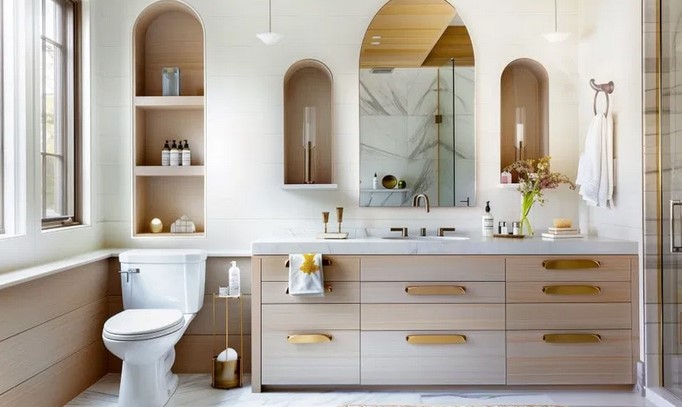
Imagine it’s 7:00 AM. You’re already running ten minutes late for a crucial meeting. You reach into your bathroom mirror for your daily moisturizer, and—clatter—a domino effect begins. Your toothbrush holder knocks over an old bottle of cough syrup, which sends a tube of expensive serum spiraling into the sink.
In my ten years of renovating bathrooms, I’ve realized that the Medicine Cabinet is often the most neglected piece of “real estate” in the home. Most people treat it like a junk drawer with a mirror attached. But when designed correctly, this small box is the command center of your morning routine. Let’s dive into how you can transform this chaotic cubby into a masterpiece of functional design.
Why the Standard Medicine Cabinet Fails (And How to Fix It)
Most off-the-shelf units are designed for a “generic” human who doesn’t exist. They come with two static glass shelves that leave huge gaps of wasted vertical space. In my experience, the biggest mistake homeowners make is not accounting for ergonomic reach zones.
Think of your Medicine Cabinet like a refrigerator. You don’t put the milk at the very back of the bottom crisper drawer, right? You put the high-frequency items at eye level. Yet, I often see people stretching for their daily meds or crouching for their floss.
The Psychology of Vertical Storage
In the world of home improvement, we call this “The Prime Zone.” Items used twice daily should occupy the center 30% of the cabinet. Items used weekly go at the bottom, and those “just in case” items (like bandages or seasonal allergy meds) go at the very top.
Functional Design: It’s What’s Inside That Counts
When we talk about optimizing a Medicine Cabinet, we aren’t just talking about tidying up. We are talking about functional integration. Here are the technical elements I look for when I’m specifying a unit for a high-end client.
1. Adjustable Shelving and “Micro-Zoning”
The secret to a professional-grade cabinet is the ability to adjust shelves in 1-inch increments. Most items in your bathroom are under 4 inches tall. If your shelves are 8 inches apart, you are wasting 50% of your volume.
-
Pro Tip: Look for cabinets with hidden track systems rather than pre-drilled holes. This allows for a much cleaner look and infinite adjustability.
-
Magnetic Strips: I always install a magnetic bar on the interior back wall. It’s perfect for bobby pins, tweezers, and nail clippers—items that usually disappear into the “abyss” of a deep shelf.
2. Integrated Power and Lighting
Modern Medicine Cabinet design has moved beyond the simple box. I now almost exclusively install units with integrated GFCI outlets and USB ports hidden inside.
-
Charging Stations: Why have your electric toothbrush and beard trimmer cluttering your limited counter space? Charging them inside the cabinet keeps the vanity “zen.”
-
Internal LED Lighting: Have you ever tried to read a tiny prescription label in a dark cabinet? Built-in lighting that triggers when the door opens is a game-changer for safety.
Technical Specifications: Recessed vs. Surface Mount
One of the first questions I get from homeowners is: “Do I have to cut into the wall?” The answer depends on your bathroom’s “anatomy.”
| Feature | Recessed Mount | Surface Mount |
| Aesthetics | Seamless, built-in look | More traditional, “protruding” |
| Installation | Complex (requires framing) | Simple (hangs like a picture) |
| Storage Depth | Limited by wall studs | Flexible |
| Room Impact | Makes small rooms feel larger | Can feel bulky in tight spaces |
Expert Insight: If you choose a recessed Medicine Cabinet, always check for plumbing stacks or electrical conduits behind the wall before you cut. I once had a client who tried a DIY install and sliced right into the main vent pipe—a $1,200 mistake that could have been avoided with a simple stud finder.
The “LSI” of Sanitary Storage: Beyond the Mirror
To truly optimize your space, you need to understand the technical environment of a bathroom. We are dealing with high humidity, vapor pressure, and temperature fluctuations.
-
Mirrored Interior: This isn’t just for vanity. A mirrored back panel reflects light into the corners of the cabinet, helping you find that small bottle of eye drops without a flashlight.
-
Soft-Close Hinges: In a “hardened” bathroom design, we want to eliminate the “clash” of glass on metal. 110-degree soft-close hinges prevent the mirror from cracking over time due to forceful closing.
-
Defogger Pads: Higher-end units include a heating element behind the glass. This ensures that even after a steaming hot shower, your mirror is crystal clear and ready for use.
Organizing Like a Pro: The Three-Tier System
I tell my clients to treat their Medicine Cabinet like a luxury hotel minibar—everything should have a dedicated “slot.”
-
The Top Tier (Infrequent Use): First aid kits, thermometer, backup razor blades, and seasonal items.
-
The Middle Tier (The Ritual): Deodorant, moisturizer, serums, and daily prescription medication. This should be at exactly eye level.
-
The Bottom Tier (The Heavy Hitters): Toothbrush, toothpaste, and heavy glass jars that could damage the lower shelves if they fell from a height.
Hidden Warning: Avoid storing liquid medications or expensive perfumes in your bathroom cabinet if you don’t have proper ventilation. The heat and humidity from the shower can degrade the chemical composition of many drugs and scents. If your bathroom stays “muggy” for more than 20 minutes after a shower, move your meds to a cool, dry linen closet.
Aesthetic Integration: Making it “Invisible”
A functional Medicine Cabinet shouldn’t look like a clinical box. I love using frame-on-frame designs where the mirror is slightly larger than the cabinet box. This creates a “shadow gap” that makes the unit appear to float on the wall.
For a minimalist look, consider a triple-door configuration. This gives you a panoramic view of the back of your head (great for hair styling) and provides enough storage for a couple to have completely separate “territories,” which, in my experience, is the secret to a happy marriage.
Your bathroom should be a place of preparation, not frustration. By investing in a high-quality Medicine Cabinet and applying functional design principles—like vertical zoning, integrated power, and proper lighting—you aren’t just “organizing.” You are engineering a better start to your day.
If you’re staring at a cluttered vanity right now, I want you to do one thing: Measure your current storage. Are you using the full height of your walls? Or are you letting prime space go to waste?
I’d love to hear from you: What’s the one item in your bathroom that currently has no “home”? Leave a comment below, and I’ll give you my expert take on where it should live!