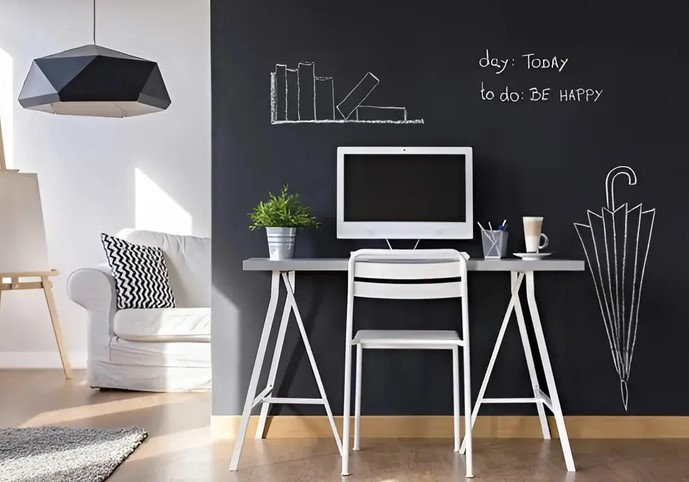
Imagine stepping into a bustling family kitchen or a dynamic home office where sticky notes are curled up on the floor, the refrigerator is buried under a chaotic avalanche of magnets, and family members are constantly asking, “What’s the Wi-Fi password?” or “What’s for dinner?” It is a classic communication breakdown, and standard plain drywall does absolutely nothing to help solve it.
Over my ten-plus years as a home improvement contractor, I have walked into hundreds of homes suffering from this exact visual clutter. Homeowners often believe that adding organization requires installing bulky, expensive command centers or drilling into pristine walls to hang heavy framed whiteboards.
But here is a pro-grade secret I discovered during a commercial office build-out years ago: you do not need new furniture to improve facility communication; you just need to transform the utility of your existing surfaces.
Opening a single chalkboard paint can can immediately convert a dead architectural asset—like an uninspiring hallway wall, a hollow-core pantry door, or the side of a kitchen island—into a dynamic, erasable communication hub. Let’s dive deep into the material science, preparation protocols, and application techniques required to turn any ordinary surface into an extraordinary interactive canvas.
The Chemical Blueprint: What is Inside the Can?
To achieve a flawless, smooth writing surface, you cannot treat this specialty product like standard interior latex paint. The formulation inside a high-quality chalkboard paint can is uniquely engineered with specific structural properties.
Think of standard wall paint like smooth, flexible silk drapery. It is designed to look beautiful and deflect light, but if you repeatedly run sharp chalk over it, the soft resin will score, scratch, and wear away within days.
[Standard Latex Paint]  -> Soft Acrylic Resin -> Scratches Easily under Chalk Pressure
[Chalkboard Paint Can]  -> Hard Quartz Silica  -> Dense Matting Agents -> Erasable Matte Surface
Chalkboard paint functions more like liquid stone. It is packed with incredibly hard matting agents—often containing ground quartz dust or specialized silica—alongside a rigid acrylic or oil-based binder. When it cures, it forms an incredibly dense, non-reflective, micro-textured barrier that can withstand the abrasive friction of chalk sticks and damp microfiber erasers over thousands of cycles.
Technical Specifications: Choosing Your Weapon
Before you head to the home improvement center or start ordering supplies, you must match the product line to your specific application environment and skill level.
1. Water-Based Acrylic vs. Alkyd (Oil-Based) Formulas
For 90% of indoor residential projects, water-based acrylic formulas found in a standard chalkboard paint can are superior. They feature low Volatile Organic Compounds (VOCs), dry rapidly, and clean up easily with warm soap and water. Alkyd alternatives are exceptionally tough and excellent for high-traffic commercial spaces or outdoor message boards, but they require mineral spirits for cleanup and carry a heavy odor during curing.
2. Standard Black vs. Tintable Bases
Do not assume your new creative surface has to look like an old-school 1950s classroom. While classic slate black and deep hunter green are highly popular, many manufacturers now offer a tintable deep base. This allows you to mix custom shades like navy blue, charcoal gray, or even burnt orange to match your existing interior color palette perfectly.
Surface Optimization: The Secret to Avoiding Ghosting
The single most common complaint I hear from DIYers is “ghosting”—a frustrating phenomenon where you erase your chalk writing, but a faint, permanent silhouette of the old message remains forever burned into the wall.
This failure does not happen because you bought a bad chalkboard paint can. It happens due to poor surface preparation and a failure to perform what professionals call surface conditioning. Here is the step-by-step protocol to ensure your surface remains pristine for years.
Step 1: Substrate Leveling and Repair
Chalkboard paint has a dead-flat matte finish, which means it will ruthlessly amplify every single lump, bump, or drywall texture underneath. Use a lightweight joint compound to patch nail holes and sand down any orange-peel wall textures using 220-grit sandpaper. The surface must feel as smooth as glass before you open the paint.
Step 2: High-Adhesion Primer Application
Apply one coat of a high-quality, stain-blocking acrylic primer. This seals the porous drywall or wood substrate, ensuring that the specialized resins in your chalkboard coat do not sink unevenly into the wall, which creates rough, un-erasable dry spots.
Step 3: Precision Application Technique
Stir the chalkboard paint can thoroughly for at least two full minutes to redistribute the heavy silica sediments settled at the bottom. Use a 3/8-inch nap microfiber roller for smooth drywall, or a high-quality synthetic brush for trim panels. Apply a minimum of two to three thin coats, waiting exactly four hours between each coat to allow the film thickness to stabilize.
💡 Pro Tip: The Essential 48-Hour Chalk Cure
Once your final coat is applied, do not touch it with chalk right away. The paint may feel dry to the touch within an hour, but it takes a full 48 to 72 hours for the chemical binders to fully cross-link and harden. Once fully cured, you must condition the surface: take a piece of standard chalk, lay it flat on its side, and rub it completely over the entire painted area until it is white. Buff it off with a dry microfiber cloth. This creates a microscopic base layer of chalk dust that prevents future writing from embedding permanently into the resin!
The Liquid Chalk Marker Trap
Here is a critical warning from a contractor who has had to repaint several kitchen panels: be incredibly cautious with modern liquid chalk markers.
While traditional pressed dust chalk works perfectly on any brand of chalkboard paint, liquid chalk markers use chemical inks that rely on porous absorption. If you write with these markers on a water-based chalkboard paint that has not been heavily sealed or thoroughly conditioned, the liquid pigment will seep deep into the micro-pores of the paint film. When you try to wipe it away, it will be permanently stained, forcing you to sand the entire wall down and start from scratch. Stick to traditional dry chalk unless the paint label explicitly states it is compatible with wet-ink markers.
Unlocking Dynamic Spatial Utility
Investing a weekend and a single chalkboard paint can into your home layout is one of the most functional upgrades you can perform. It bridges the gap between raw home infrastructure and daily human connection. Whether you are charting out a corporate-style project timeline in your home office, mapping out weekly meal preps in the kitchen, or giving your toddlers a designated space to create art directly on the walls without getting grounded—you are creating a resilient, evolving canvas that adapts to your life.
Are you ready to eliminate the clutter of paper notes and add a creative communication zone to your facility this weekend? What wall or door in your home is currently sitting empty, waiting for a functional transformation? Let me know your thoughts and layout ideas in the comments below, and let’s get painting!