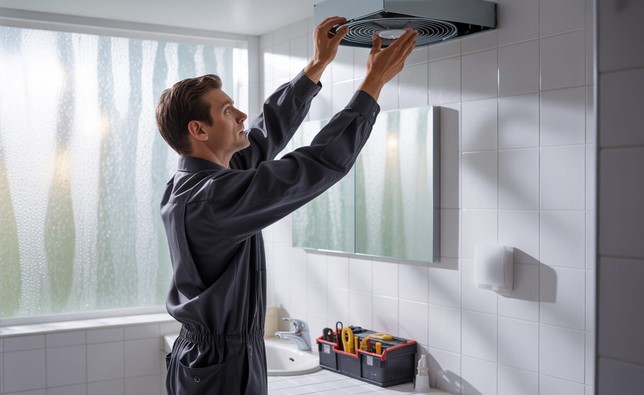
A few years back, I inspected a home in Seattle where the owner was convinced he had a roof leak directly above his master bathroom. Black mold spots were bleeding through the ceiling drywall, and the paint was peeling off the walls in thick ribbons.
When I climbed into the attic, I found the real culprit: a previous contractor had routed the bathroom vent fan duct directly into the attic insulation rather than through the exterior roof cap. Every hot shower pushed gallons of atomized water into the cold attic framing, rotting the roof rafters from the inside out.
Fixing that single duct line and sizing a proper bathroom vent fan saved the home’s roof structure. Over my 10+ years in structural remediation and building science, I have learned that a bath fan is not just an afterthought to clear mirror fog—it is a critical mechanical ventilation system engineered to preserve your home’s structural integrity and indoor air quality.
The Hidden Cost of Moisture: Why a High-Performance Bathroom Vent Fan Matters
When you take a 10-minute hot shower, you release roughly half a pint of liquid water into the air as micro-droplets of vapor. Without active mechanical exhaust, that moisture saturates drywall, seeps behind tile grout, and fosters toxic Stachybotrys chartarum (black mold) colonies in less than 48 hours.
Think of your home’s air envelope like a sealed plastic bottle. If you continuously add steam inside without an exhaust port, the internal pressure and humidity rise until moisture condenses on every cool surface.
Installing an accurately sized bathroom vent fan acts as a vacuum relief valve. It pulls saturated, low-density moist air out of the enclosure while drawing drier air in from surrounding rooms to equalize humidity levels.
+-----------------------------------------------------------------------+
|                    Bathroom Moisture Dynamics                         |
|                                                                       |
|  [ Hot Shower Stream ] ---> High Relative Humidity & Steam            |
|                                   ||                                  |
|  [ Bathroom Vent Fan ] ---> Extracts Saturated Air to Exterior        |
|                                   ||                                  |
|  [ Fresh Makeup Air ]  <--- Drawn Under Door Jamb to Prevent Mold     |
+-----------------------------------------------------------------------+
Engineering Mechanics: Sizing CFM, Sone Ratings, and Duct Dynamics
Choosing the right unit requires understanding fan motor mechanics, volumetric airflow, and acoustic performance metrics.
1. Airflow Volume: Cubic Feet per Minute (CFM)
The standard rule of thumb from the Home Ventilating Institute (HVI) is simple: you need 1 CFM per square foot of floor space for bathrooms under 100 square feet. For larger master suites, calculate capacity by adding dedicated fixture allocations:
-
Toilet: 50 CFM
-
Shower Enclosure: 50 CFM
-
Steam Shower: 100 CFM
-
Jetted Whirlpool Tub: 50 CFM
2. Acoustic Output: Sone Ratings
A fan’s sound output is measured in Sones. Lower numbers mean quieter operation:
-
4.0 Sones or higher: Equivalent to a loud TV or kitchen blender (typical builder-grade noise).
-
1.5 to 2.0 Sones: Moderate hum; acceptable for guest bathrooms.
-
0.3 to 1.0 Sone: Whisper-quiet; ideal for master suites and continuous ventilation routines.
| Parameter | Builder-Grade Fan | High-Efficiency Modern Fan |
| Airflow Capacity | 50–70 CFM | 110–150+ CFM |
| Noise Level | 3.5–5.0 Sones | 0.3–0.8 Sones |
| Motor Type | AC Induction (High Power) | DC Brushless (Low Power) |
| Integrated Features | Basic Toggle Switch | Humidity Sensor / Motion Sensor |
Step-by-Step Field Execution: Installing Your Bathroom Vent Fan for Maximum Efficiency
Installing a bathroom vent fan demands proper duct routing and electrical wiring to achieve rated performance:
-
Calculate Total Equivalent Duct Length: Use rigid smooth-walled metal ducting whenever possible. Every 90-degree elbow adds the equivalent of 10 feet of straight duct resistance to your fan motor.
-
Mount Securely to Ceiling Joists: Anchor the housing box directly to solid framing timbers using joist brackets. Loose ceiling installations rattle against the drywall, creating annoying acoustic vibration noise.
-
Insulate Attic Duct Runs: Always wrap exhaust ducts in R-6 or R-8 fiberglass insulation when passing through unheated attic spaces. Uninsulated ducts cause rising steam to condense into water droplets inside the pipe, running backward into the fan motor housing.
-
Terminate to the Exterior Wall or Roof Cap: Ensure the duct terminates at a dedicated roof cap or exterior wall hood equipped with a backdraft damper. Never exhaust into an attic, soffit vent, or basement crawlspace.
Pro Tips for Automated Moisture Control and Maintenance
Over a decade of troubleshooting indoor air quality issues, I have established key practices to keep systems running at peak performance:
Pro Tip: Replace basic wall switches with a digital humidity-sensing wall switch or a countdown timer. Running your bathroom vent fan for 20 minutes post-shower is required to purge lingering moisture from wall cavities and shower enclosures.
Perform a simple Dollar Bill Vacuum Test once every six months to check performance. Turn the fan on and place a single dollar bill flat against the intake grille. If suction holds the paper firmly in place, your airflow velocity is working properly.
Hidden Warnings: 3 Mistakes That Destroy Vent Fan Efficiency
Avoid these three frequent installation mistakes that ruin fan performance and cause structural damage:
-
Warning 1: Using Flexible Slinky Vinyl Ducting. Flexible ribbed ductwork creates extreme friction loss, reducing your actual CFM airflow by up to 50%. Always use rigid smooth aluminum or galvanized steel ducting.
-
Warning 2: Venting Air Out Through Soffit Overhangs. Exhausting moist air through soffit vents allows the warm steam to be sucked right back into the attic framing through nearby intake vents.
-
Warning 3: Forgetting Makeup Air Clearance. High-powered fans cannot pull air out of a bathroom if the door creates an airtight seal against the threshold. Maintain a 3/4-inch gap beneath the bathroom door to allow fresh makeup air to flow freely into the room.
  [ Incorrect Soffit Venting ]
               ||
               \/
+-------------------------------+  <-- Soffit Exhaust Cap
| Moist Air Rises Upward (X)    |  <-- Pulled back into attic intake!
+-------------------------------+
| Attic Under-Eave Cavity       |  <-- Causes rafter rot & attic mold
Optimizing your home’s indoor air quality isn’t about buying expensive gadgets; it comes down to applying basic building physics. By selecting a high-CFM, low-Sone bathroom vent fan, insulating your exterior duct runs, and allowing proper makeup airflow, you protect your structural framing and maintain a healthy, mold-free home for years to come.
Are you upgrading an existing bath fan or troubleshooting persistent humidity and fogged mirrors in your home? What challenges are you facing with your current bathroom setup? Share your questions or project ideas in the comments below!