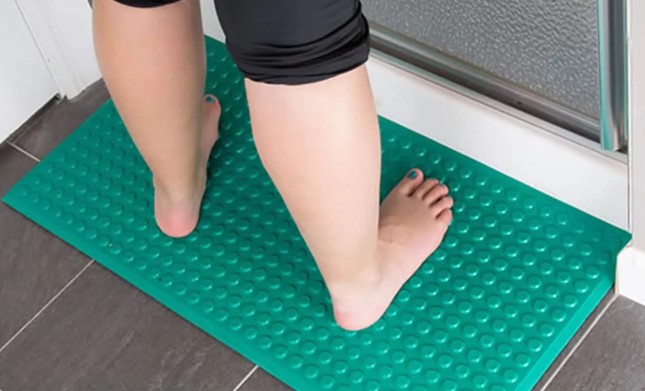
You step out of the shower, clean, relaxed, and completely off-guard. Your wet foot hits a slick, low-traction tile floor, and in a split second, gravity takes over. Your arms flail, your lower back twists violently to compensate, and you narrowly avoid a catastrophic hospital visit.
According to safety data from the Center for Disease Control (CDC), over 200,000 bathroom slip-and-fall accidents occur annually in residential homes, with the vast majority happening right outside the tub or shower stall.
Over my ten-plus years as a residential home improvement and accessibility contractor, I have re-engineered countless home layouts to optimize wellness and safety. Homeowners routinely spend thousands of dollars on high-end anti-fatigue mats for their commercial kitchens or standing office desks to achieve workplace wellness. Yet, they treat the most dangerous, high-moisture zone in their entire house as an afterthought, tossing down a flimsy, worn-out piece of cotton fabric that slides around like an oil slick.
Everything shifted for my clients when I stopped looking at bathroom flooring accents as simple textiles and started treating them as vital kinetic safety gear. Integrating a high-performance bath mat memory foam system is the ultimate low-cost, high-return home improvement hack to stabilize your footing, protect your joints, and eliminate slipping hazards.
The Physics of Pressure: Why Polyurethane Core Outperforms Cotton
To understand why traditional woven mats fail, we have to examine the mechanical forces at play when your foot meets the floor. A standard thin cotton rug lacks kinetic absorption; it immediately flattens against the hard substrate, passing 100% of the impact force right back into your calcaneus (heel bone) and ankle joints.
Think of stepping onto a standard bath mat like driving a vintage car with completely blown-out suspension struts directly over a massive pothole. You feel every single bit of the jarring vibration rattle right up through the chassis of your body.
[Wet Foot] -> Flat Cotton Rug -> Hard Tile Compression -> Joint Impact & High Slippage Risk
[Wet Foot] -> Memory Foam Core -> Custom Contour Mold    -> Shock Absorption & Mechanical Grip
Deploying a technical bath mat memory foam upgrade is like swapping that old suspension out for an advanced, modern hydraulic shock absorber. The open-cell polyurethane foam reacts dynamically to the combination of your body heat and downward kinetic mass, flowing and contouring to mirror the unique longitudinal arch of your foot. This uniform distribution of pressure maximizes physical stability and provides an exceptional grip on the floor below.
Technical Specifications: The Anatomy of a Resilient Safety Mat
Not all foam accessories are built to withstand the punishing environment of a modern residential bathroom. If you buy a cheap, poorly engineered model from a discount store, the foam will collapse within a month and turn into a soggy, mold-ridden hazard.
When sourcing your home wellness gear, you must look for these specific engineering standards:
1. High-Density Polyurethane Core Thickness
For true ergonomic value and shock absorption, look for a core thickness of at least 0.6 inches to 0.75 inches (15mm to 19mm). Lower-grade 10mm foam compresses entirely to zero under a standard adult’s weight, completely defeating the purpose of the ergonomic cushioning.
2. SBR or PVC Non-Slip Backing (The Mechanical Anchor)
The backing material is the single most critical safety component. Avoid cheap spray-on latex backings, which disintegrate after three cycles in the washing machine. Insist on a heavy-duty, textured Styrene-Butadiene Rubber (SBR) or embossed PVC backing that creates a reliable mechanical coefficient of friction against slick ceramic tiles.
3. Coral Fleece Substrate and GSM Rating
The top fabric face should be made of a high-density coral fleece or microfiber with a high Grams per Square Meter (GSM) rating—ideally above 250 GSM. This ensures rapid capillary action, pulling water away from the surface instantly so the top layer feels dry to the touch even after multiple consecutive family members use the shower.
Strategic Placement Guidelines for Full Bathroom Optimization
To maximize your household’s safety infrastructure, you should treat these mats exactly like industrial anti-fatigue zones in a workplace environment.
-
The Splash Zone (The Primary Anchor): Place your primary long mat parallel to the exit of the tub or walk-in shower. The mat must be centered precisely with the entry door to ensure both feet land squarely on the foam core when stepping out sideways.
-
The Vanity Workstation: If you spend 15 to 20 minutes standing in front of the sink every morning brushing your teeth, shaving, or doing makeup, place a secondary bath mat memory piece there. This acts as a true anti-fatigue pad, reducing lower back strain and calf fatigue while standing on cold, unyielding concrete or tile substrates.
💡 Pro Tip: The Hydrophobic Trapped-Moisture Warning
While the SBR rubber backing is incredible for preventing slip hazards, it creates a total vapor barrier beneath the mat. If your tile floor has unsealed grout lines, ambient moisture can slowly collect under the rubber backing over time, creating a hidden breeding ground for mildew. To completely avoid this, pick up the mat once a week on cleaning day, wipe the subfloor dry, and drape the mat over the edge of the tub to allow the bottom layer to air out completely.
Maintenance Architecture: Keeping Foam Elastic
The biggest enemy of high-density memory foam is incorrect laundering. Many homeowners treat their safety mats like tough denim jeans, washing them in hot water and throwing them into a commercial dryer on high heat.
This will permanently melt the backing and destroy the foam’s elasticity. To protect your asset, wash the mat in cold water on the gentle cycle with a mild detergent. Always skip the fabric softener, which coats the microfiber strands in an oily film and cuts the mat’s water absorption capacity in half. Line dry the mat or use the absolutely lowest air-fluff setting on your dryer.
Elevating Residential Workplace Wellness
At the end of the day, home improvement is about transforming your living spaces into a safe, sustainable sanctuary. Investing in a scientifically backed bath mat memory setup bridges the gap between basic interior decoration and high-level ergonomic engineering. By protecting your body from impact stress and securing your footing against wet surfaces, you elevate your daily routine and protect your family from preventable injuries.
Are you ready to audit your bathroom flooring and upgrade to a safer, more comfortable setup this weekend? What kind of flooring material do you currently have in your home’s highest moisture zones? Let me know in the comments below, and let’s get your home styled for safety!