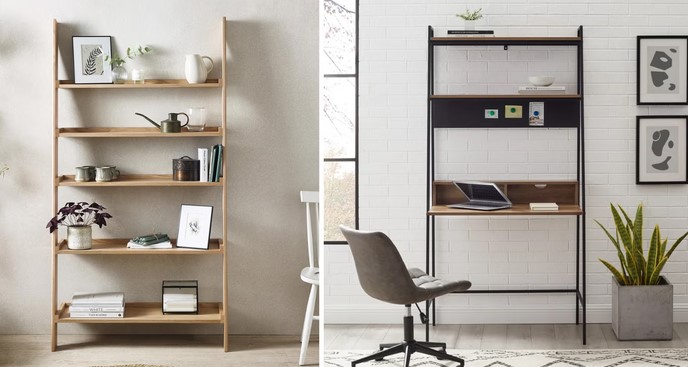
A few years ago, I was hired to redesign a home study for an executive who was struggling with a claustrophobic workspace. His office was dominated by two massive, dark mahogany traditional bookcases that blocked natural window light, swallowed floor space, and made a 150-square-foot room feel like an underground vault. The moment we swapped those bulky monoliths for a pair of solid wooden leaning shelves, the entire atmosphere shifted. The room suddenly felt airy, sophisticated, and surprisingly twice its original size.
Over my ten-plus years in residential design and custom cabinetry, I’ve seen this exact transformation over and over again. Heavy, boxy furniture is rapidly becoming a relic of the past as modern workspaces prioritize fluid sightlines and intentional spatial organization.
Choosing a ladder bookcase wood structure isn’t just an aesthetic choice for minimalist interior design; it is a smart architectural solution. By capitalizing on vertical wall real estate while reducing visual bulk at eye level, a wooden ladder shelf balances structural integrity with effortless elegance. Let’s explore how to choose, anchor, and style this essential piece of functional decor.
The Spatial Physics of Leaning Design: Why Ladder Shelving Works
To understand why a wooden leaning bookcase feels so light in a room, you have to look at the geometry of sightlines and weight distribution.
Standard bookcases are rectangular boxes that extend straight up, creating a uniform wall of solid wood from floor to ceiling. A leaning ladder shelving unit, however, utilizes a tapered silhouette—wider at the base and narrower at the top.
Think of a traditional bookcase like a tall, solid brick wall, while a wooden ladder bookcase is like an open, step-ladder framework. Light flows around the open sides and angled uprights, allowing your eyes to perceive the full perimeter of the room behind the furniture.
+-----------------------------------------------------------------------+
|                       SPATIAL SIGHTLINE DYNAMICS                      |
|                                                                       |
|   TRADITIONAL BOOKCASE:  [ Solid Box ] =====> (Blocks Light & Sight)  |
|                                                                       |
|   LADDER BOOKCASE:       \ Open Frame \ ====> (Passes Light Through)  |
+-----------------------------------------------------------------------+
Because the top shelves are shallower than the bottom shelves, the unit naturally recedes from your primary field of view as it rises toward the ceiling. This tapering effect tricks the brain into perceiving higher ceilings and a more expansive floor plan.
Material Engineering: Hardwood Species, Joinery, and Load Capacity
When shopping for a ladder bookcase wood piece, you must look beyond surface stains and evaluate the structural integrity of the timber and joinery. Not all wood types handle static shelf loads equally.
+-----------------------------------------------------------------+
|                   TIMBER PERFORMANCE COMPARISON                 |
+----------------------+--------------------+---------------------+
| Wood Species / Type  | Janka Hardness     | Load-Bearing Ability|
+----------------------+--------------------+---------------------+
| Solid White Oak      | High (1,360 lbf)   | Heavy Duty          |
| American Walnut      | Medium (1,010 lbf) | High / Luxury Finish|
| Solid Pine / Cedar   | Low (380-690 lbf)  | Light to Medium     |
| Veneered MDF / PB    | Variable           | Prone to Sagging    |
+----------------------+--------------------+---------------------+
1. Solid Hardwood vs. Engineered Wood
-
Solid Hardwoods (Oak, Walnut, Ash): These offer maximum flexural strength. The natural grain structure resists shelf bowing (deflection) even when packed with heavy legal volumes or art books.
-
Engineered Wood (MDF or Particle Board): While budget-friendly, long shelves made from particle board will sag under moderate weight over time, especially in high-humidity home environments.
2. Joinery Details That Matter
Examine how the horizontal shelf tiers connect to the angled vertical stiles:
-
Mortise and Tenon or Dado Joints: The gold standard in woodworking. The shelf slides directly into a carved groove in the vertical side rail, transferring weight into the solid frame.
-
Simple Pocket Screws: Common in cheaper flat-pack kits. Over time, leaning forces can loosen screw holes in soft materials, causing the frame to wobble.
Gravity and Anchoring Protocols: The Physics of Wall Safety
A common misconception among DIYers is that a leaning shelf relies purely on friction to stay upright. In reality, a ladder bookcase wood unit creates a dynamic vector force pushing down into the floor and back into the wall.
+-----------------------------------------------------------------+
|                    VECTOR FORCE DISTRIBUTION                    |
|                                                                 |
|                 [ Upper Wall Contact Point ]                    |
|                             \                                   |
|                              \  (Downward & Lateral Force)      |
|                               \                                 |
|                      [ Lower Floor Contact Point ]              |
+-----------------------------------------------------------------+
Essential Anchoring Mechanics
Even though gravity presses the top of the frame against the drywall, heavy books or accidental bumps can disrupt the equilibrium and cause a catastrophic tipping incident.
-
Locate Wall Studs: Always secure top mounting brackets into solid wood wall studs using 2.5-inch cabinet screws.
-
Use Heavy-Duty Toggle Bolts: If a stud isn’t aligned with your desired placement, use high-capacity metal toggle anchors rather than plastic dry-wall plugs.
-
Floor Leveling: Garages and older homes often feature sloped floors. Use subtle felt pads or adjustable leveling feet under the base legs to ensure equal contact pressure across both uprights.
Pro Tip: Look for wooden ladder shelves with pre-cut base notch-outs! High-end designs include a recessed cutout at the bottom of the side rails to accommodate standard 4-inch baseboard trim, allowing the unit to rest completely flush against the upper wall surface without awkward gaps.
Curating the Taper: Visual Balance and Weight Distribution
Styling a minimalist wooden ladder shelf requires a balanced approach to both visual weight and physical load distribution.
1. Bottom-Heavy Load Strategy
Place your heaviest items on the deepest bottom shelves to lower the unit’s center of gravity:
-
Bottom Tiers (14–16 inches deep): Heavy storage baskets, oversized art books, records, or printer equipment.
-
Middle Tiers (10–12 inches deep): Hardcover literature, framed family photos, and medium-sized ceramics.
-
Top Tiers (6–8 inches deep): Delicate sculpture pieces, trailing houseplants (like pothos), or small decorative accents.
+-----------------------------------------------------------------+
|                   SHELF WEIGHT & DEPTH MATRIX                   |
+-----------------------------------------------------------------+
| TOP TIER (6"-8" Deep)    | Light Accents & Small Plants         |
+--------------------------+--------------------------------------+
| MID TIER (10"-12" Deep)  | Standard Books & Framed Art          |
+--------------------------+--------------------------------------+
| BASE TIER (14"-16" Deep) | Heavy Books, Baskets & Storage Bins  |
+-----------------------------------------------------------------+
2. The Rule of Visual Negative Space
Avoid packing every inch of every shelf from end to end. Leave at least 30% of each shelf tier open to let the background wall show through. This negative space preserves the open, floating feel that makes ladder shelving so appealing.
Hidden Danger Alert: Beware of top-heavy plant placement! Trailing plants look fantastic on top shelves, but overwatering can cause excess runoff to seep into unsealed wood grain, warping the top shelf and creating a top-heavy water hazard if the pot is ceramic or clay. Always use non-porous drip trays beneath indoor planters.
Essential Selection and Care Checklist
Before purchasing or installing your new wooden ladder bookcase, run through this quick checklist:
-
[ ] Timber is high-density solid hardwood (such as Oak, Walnut, or Ash) treated with a protective matte poly finish.
-
[ ] Shelves utilize mortise-and-tenon or recessed dado joinery for maximum weight capacity.
-
[ ] Base legs include notch-outs to clear standard baseboard trim.
-
[ ] Unit includes solid metal anti-tip wall brackets and hardware for mounting into studs.
-
[ ] Heavy items are placed on the lower two tiers to maintain a low center of gravity.
-
[ ] Wood surfaces are dusted with a microfiber cloth and conditioned annually with natural beeswax polish.
Swapping out bulky, dark storage for an elegant ladder bookcase wood feature is one of the most effective ways to open up a room while adding warmth and character. By combining smart spatial physics with solid timber joinery, you can build an executive workspace that feels organized, open, and timeless.
How is storage currently configured in your home office or living room? Are you working with traditional closed cabinets or looking to transition to open, leaning architecture? Drop a comment below with your setup or questions—I’d love to help you plan your next space upgrade!